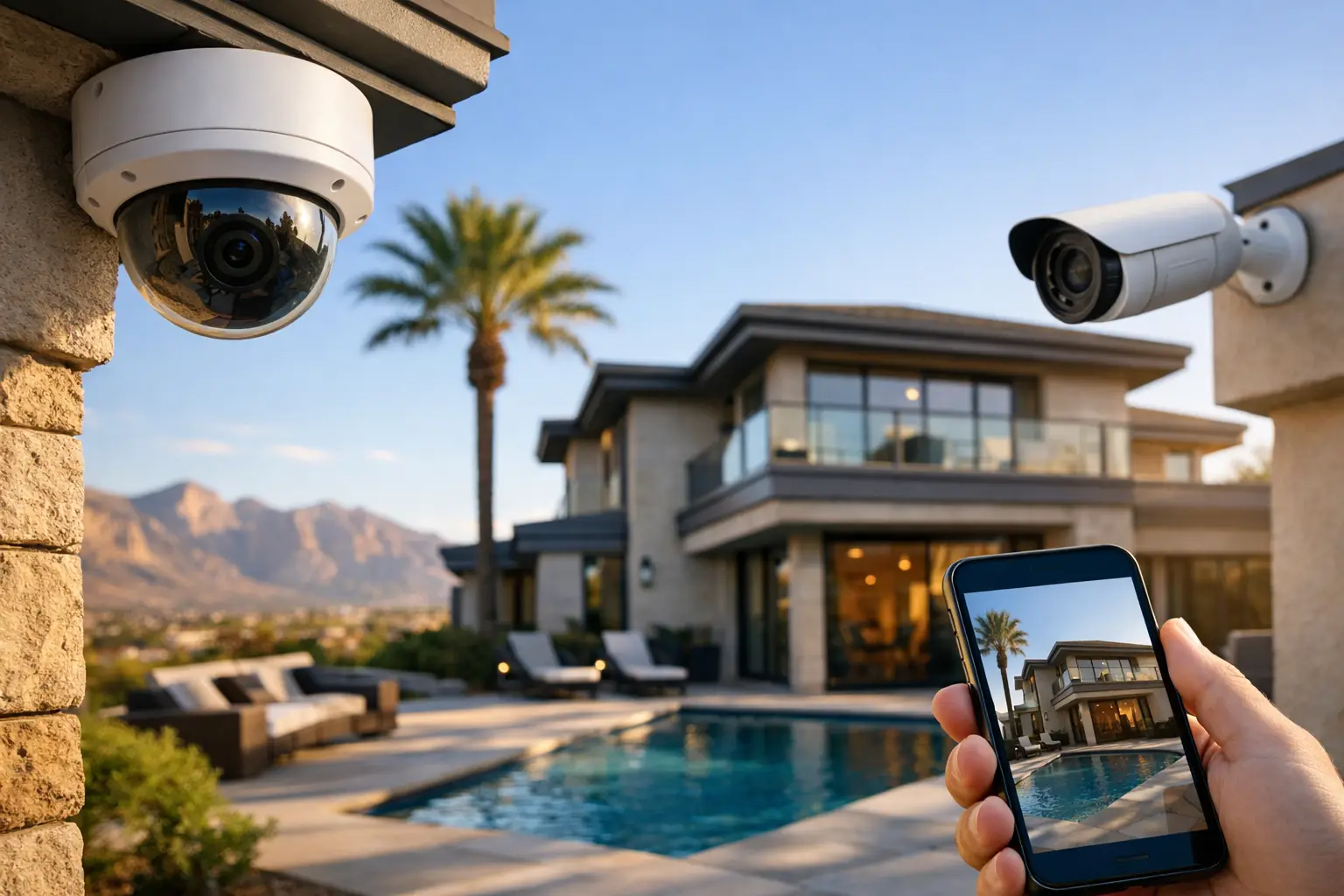
A smart home stops feeling smart pretty quickly when the door lock lags, the cameras drop offline, and the Wi-Fi dies in the back bedroom. That is why the future of home automation is not really about adding more gadgets. It is about making the whole system more dependable, easier to manage, and actually useful in daily life.
For homeowners in Las Vegas, that shift matters. A bigger house, more connected devices, detached casitas, outdoor cameras, pool equipment, home theaters, and work-from-home setups all put pressure on the network underneath everything else. If the foundation is weak, the fancy features do not help much. The next phase of home automation is moving away from novelty and toward well-planned systems that handle security, comfort, entertainment, and connectivity without constant troubleshooting.
The future of home automation starts with the network
Most people think about home automation in terms of visible devices – thermostats, lighting, cameras, shades, speakers, and smart locks. In practice, the real system starts with the network. If coverage is uneven or device traffic is poorly managed, automation becomes frustrating fast.
That is why stronger Wi-Fi design is becoming part of the conversation, not an afterthought. Homes are adding more connected equipment every year, and many of those devices are always on. Cameras upload constantly. Streaming devices pull bandwidth every night. Voice assistants wait for commands. Access points, proper placement, hardwired backhaul, and clean low-voltage cabling matter more now than they did even a few years ago.
This is one of the biggest changes in the future of home automation. The winning setup will not be the one with the most devices. It will be the one built on stable infrastructure that can support those devices without slowing down the rest of the house.
More automation, less app switching
One of the biggest complaints homeowners have today is simple: too many apps. One app for cameras, another for lights, another for the thermostat, another for the garage, and maybe another for audio. That setup works at first, but it gets old fast.
The next stage of automation is better integration. Instead of managing disconnected products one by one, homeowners want scenes and routines that bring multiple systems together. A single command can lock the doors, arm the alarm, turn off interior lights, adjust the thermostat, and close the garage. A nighttime routine can dim common areas, shut off outdoor audio, and check whether side gates or access points were left open.
That does not mean every home needs a fully custom control platform. In some cases, a simpler ecosystem is the right move. In others, especially larger homes or properties with more advanced AV, surveillance, and access needs, a professionally designed control setup makes more sense. The right answer depends on the size of the property, the number of users, and how much reliability the homeowner expects.
AI will help, but it will not replace good system design
Artificial intelligence is starting to shape the future of home automation, especially in security, energy management, and user behavior. Cameras can already do more than record footage. They can identify people, vehicles, packages, and unusual movement patterns. Thermostats can learn occupancy habits. Lighting can respond to time of day, ambient light, and room usage.
There is real value here, but there is also a lot of marketing hype. AI features are only as good as the hardware, placement, and network supporting them. A poorly positioned camera with weak connectivity does not become reliable just because it has smarter software. The same goes for voice control and predictive automation. If the microphones miss commands or the routines trigger inconsistently, people stop using them.
The practical view is this: AI can make home systems more responsive, but it does not eliminate the need for proper installation. Smart features work best when they are layered onto a well-built environment, not used as a shortcut around one.
Home security will keep driving adoption
For many homeowners, security is still the main reason to invest in smart technology. That is unlikely to change. What will change is how tightly security is connected to the rest of the home.
Cameras, video doorbells, smart locks, gate access, garage monitoring, motion sensors, and exterior lighting are moving closer together. Instead of acting as separate tools, they are becoming part of a coordinated security system. If a camera detects motion near a side yard at night, lights can come on automatically. If a door is unlocked during certain hours, the homeowner can receive an alert and pull video immediately. If a package arrives, a recording can be tagged and stored without sorting through hours of footage.
In neighborhoods with gated entries, HOA concerns, or higher expectations around property protection, these integrations are especially useful. They reduce blind spots and cut down on the small failures that create bigger problems later. The trend is not just more surveillance. It is better awareness and faster response.
Energy management will become more practical
Energy efficiency used to be one of those smart home talking points that sounded good but felt secondary. That is changing. As utility costs rise and more homes add EV charging, pool systems, detached offices, and larger entertainment setups, energy management becomes a practical issue.
Smart thermostats are only the beginning. The future points toward homes that can track and adjust lighting loads, HVAC usage, shades, appliances, irrigation timing, and occupancy patterns with more precision. In a desert climate like Las Vegas, that has obvious appeal. Keeping a house comfortable without wasting energy is not a luxury feature. It is part of running the property well.
That said, energy automation works best when expectations are realistic. You may not want aggressive occupancy rules in every room. You may not want lights turning off on guests or family members who are sitting still. Good programming should support daily life, not annoy the people living there. The best systems strike a balance between efficiency and comfort.
New homes will be smarter from the start
Builders and remodelers are starting to treat automation less like an add-on and more like infrastructure. That is a major shift. It is much easier to prepare a home for cameras, whole-home audio, access control, in-wall touch panels, dedicated Wi-Fi zones, and future upgrades when cabling and device locations are planned early.
For new construction, prewiring creates options. Even if a homeowner does not install every feature on day one, the home is ready for later phases. That avoids expensive retrofits and keeps walls closed. It also gives owners more flexibility to add systems over time as their needs change.
For existing homes, the same logic still applies, just with more attention to what is realistic. Some upgrades are simple. Others depend on access, construction type, and budget. A hands-on technology partner can usually identify where hardwiring is worth it and where a wireless approach is the smarter choice.
The best smart homes will feel simpler, not more complicated
This is probably the clearest sign of where the market is heading. People do not want a house that needs constant fiddling. They want one that works.
That means fewer unnecessary alerts, clearer control options, faster response times, and less guesswork for everyone in the household. It also means systems that can be serviced when something goes wrong. Remote support, firmware updates, device replacement, Wi-Fi optimization, and troubleshooting are becoming part of home automation ownership, especially in larger homes and higher-end setups.
This is where local support matters. When the network, cameras, AV, and smart devices all overlap, homeowners do not want to call four different vendors and sort out who is responsible. They want one team that can step in, identify the issue, and fix it. That service model is becoming more valuable as home systems become more connected.
Las Vegas Tech Pros sees this every day. The demand is not just for smart devices. It is for dependable performance across Wi-Fi, security, AV, and automation, backed by people who can actually show up and solve the problem.
What homeowners should do now
If you are thinking about the future of home automation, the smartest move is not buying random devices during a sale. Start by looking at the weak points in the home you already have. If your Wi-Fi struggles, if your cameras are inconsistent, if your lighting and locks do not work together, or if your current setup depends on too many separate apps, those are the real issues to fix first.
From there, think in layers. Build a stable network. Add security where it matters most. Integrate the systems you use every day. Leave room for growth. A well-designed setup does not need to be flashy to be valuable. It needs to be reliable on a normal Tuesday, when nobody wants to think about technology at all.
That is where home automation is headed – less novelty, more coordination, and better support behind the scenes. For most homeowners, that is not a futuristic idea. It is the version of smart living that finally makes sense.