A lot of offices are still dealing with yesterday’s problems using yesterday’s setup – weak Wi-Fi in conference rooms, disconnected security systems, messy cabling, and IT support that only shows up after something breaks. That is exactly why smart office technology trends are getting real attention from business owners, office managers, and property teams. The goal is not to chase gadgets. It is to build an office that runs better, stays secure, and gives people fewer reasons to stop what they are doing and call for help.
For most businesses, the smartest upgrades are the ones that reduce friction. If your staff cannot get on a stable network, if your cameras are hard to access, or if your meeting spaces waste 10 minutes every time someone tries to present, the problem is not just inconvenience. It is lost time, uneven service, and avoidable stress. The trends worth watching are the ones that solve those problems in a practical way.
Smart office technology trends are getting more connected
The biggest shift is not one single device. It is integration. Offices are moving away from pieced-together systems and toward setups where networking, security, audiovisual equipment, and access control work together.
That matters because disconnected systems create blind spots. A business might have good cameras, decent Wi-Fi, and modern conference room displays, but if each system is installed by a different vendor and managed separately, troubleshooting gets slow fast. When something fails, no one wants to hear that the issue belongs to somebody else.
A connected office setup makes daily operations simpler. Staff can move through secured spaces more easily, managers can check systems remotely, and troubleshooting becomes more straightforward because the infrastructure was planned as one environment instead of several unrelated projects.
Better Wi-Fi is now a core office priority
For years, many businesses treated office Wi-Fi like a background utility. As long as there was internet somewhere in the building, it felt good enough. That no longer works, especially in offices with cloud software, video calls, wireless devices, and guest access.
One of the most important smart office technology trends is the push toward stronger, more intentional wireless design. That includes better access point placement, improved coverage for dead zones, network segmentation, and ongoing monitoring instead of waiting for complaints.
This is especially important in larger suites, medical offices, multi-tenant properties, and buildings with heavy interference. In those spaces, a consumer-grade router or a quick fix usually creates more problems than it solves. A proper office network has to support daily business traffic, security devices, conferencing tools, and future expansion without becoming unstable.
There is a trade-off here. Stronger Wi-Fi infrastructure means more planning upfront. It may involve cabling work, hardware upgrades, and professional configuration. But the payoff is real because staff productivity depends on it.
Access control is replacing old key habits
Physical security is changing in a big way. More offices are replacing traditional keys with smarter access control systems that let managers decide who can enter specific areas and when.
This trend is growing because keys are hard to manage at scale. They get copied, lost, and passed around. Smart access control gives businesses more control without adding daily hassle. If an employee leaves, permissions can be changed quickly. If a vendor needs temporary access, that can be limited to a certain door and a certain time.
For office managers and property operators, this also creates better visibility. You are not just locking a door. You are creating a record of movement and tightening control around sensitive spaces like server rooms, medical records areas, or inventory storage.
That said, the right system depends on the building and the workflow. A small office may need simple keypad or credential access. A larger commercial property may need multi-door management, remote administration, and integration with surveillance. The technology is only useful if it matches how the space actually operates.
Smarter surveillance is becoming standard
Modern camera systems are doing more than recording video. Businesses want better image quality, remote viewing, alert capabilities, and storage options that make footage easier to retrieve when something happens.
This is one of the smart office technology trends that crosses industries. Small offices want visibility after hours. Medical and professional environments want to monitor entry points and public-facing areas. Commercial property operators want broad coverage without constant manual checking.
The real shift is in usability. Older systems often made footage difficult to review, especially across multiple cameras or locations. Smarter systems are designed to give owners and managers faster access to what they need. That can make a big difference in security response, insurance documentation, and general peace of mind.
Installation quality matters here more than many businesses realize. Camera placement, storage planning, network impact, and remote access settings all affect whether the system helps or creates new headaches. A camera package that looks good on paper can still fail in the real world if the cabling is poor or the viewing angles are wrong.
Meeting rooms are getting simpler, not flashier
A lot of businesses assume conference room technology has to be complicated to feel modern. In practice, the best upgrades are usually the ones that remove extra steps.
That is why another major trend is simplified AV and conferencing. Offices want displays that connect reliably, audio that people can actually hear, and systems that work the first time without someone crawling under a table looking for the right cable.
For hybrid teams, this matters even more. A meeting room is no longer just a room with a screen. It is part of how the business communicates with clients, vendors, and remote staff. If the sound is weak or the video setup is inconsistent, it reflects poorly on the company and wastes time every week.
Good AV design is not just about buying better equipment. It is about matching room size, acoustics, display placement, and user habits. A smaller office may only need a clean wall-mounted display and dependable wireless presentation. A larger boardroom may need a more complete microphone, camera, and control setup.
Low-voltage infrastructure is finally getting attention
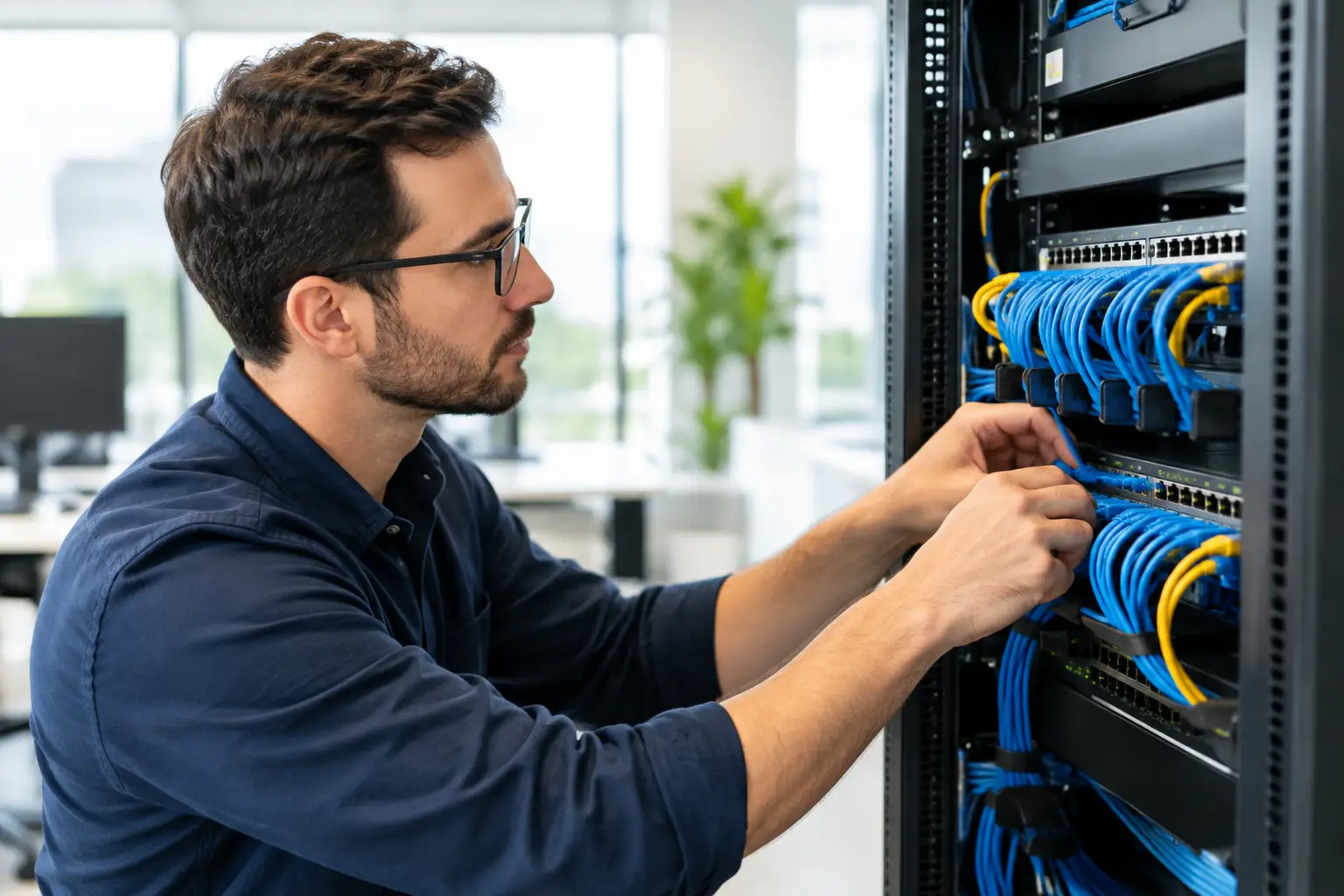
One trend that often gets overlooked is the growing focus on the wiring behind the walls. Businesses are paying more attention to low-voltage cabling because they have learned the hard way that poor infrastructure causes long-term problems.
When office technology expands without a cabling plan, the result is usually patchwork. You see exposed wires, mislabeled drops, unreliable device connections, and wasted time during moves or upgrades. That becomes expensive fast, especially when multiple vendors touch the same space over time.
Smart offices depend on strong physical infrastructure. Networks, cameras, access control, and AV systems all perform better when the cabling is designed cleanly and installed correctly from the start. For builders, HOAs, and commercial property owners, this is one of the easiest ways to protect future flexibility.
It may not be the most visible upgrade, but it is often one of the most valuable. A clean cabling foundation makes every future technology decision easier.
Managed support is becoming part of the office itself
Another of the most practical smart office technology trends is the move toward ongoing support instead of one-time fixes. Businesses are realizing that technology is not really a set-it-and-forget-it investment.
Networks need monitoring. User issues need quick response. Security devices need updates. Conference systems need occasional adjustments. If every problem triggers a new search for a vendor, downtime stretches out and accountability gets fuzzy.
That is why many offices now want a technology partner who can handle multiple systems under one roof. Instead of calling one company for Wi-Fi, another for cameras, another for access control, and another for AV, they want one team that understands how everything connects. For businesses in a fast-moving market like Las Vegas, that kind of responsiveness matters.
Las Vegas Tech Pros fits naturally into that need because many local businesses are not looking for theory. They want someone who can show up, identify the issue, fix the underlying problem, and keep the office moving.
What businesses should do before making upgrades
The right move is not to buy the newest thing. It is to start with the pain points that slow your team down or leave gaps in security and reliability.
If the office struggles with dropped connections, start with the network. If key management has become a problem, look at access control. If your conference room wastes time every week, improve the AV setup. If your systems feel disconnected, step back and create a plan that treats the office as one technology environment instead of separate pieces.
That approach usually saves money over time because it avoids duplicate work, rushed installs, and tools that do not fit together. Smart office upgrades work best when they are built around how your people use the space every day.
The most useful trend is not a device or a platform. It is the shift toward offices that are easier to manage, faster to support, and better prepared for growth.